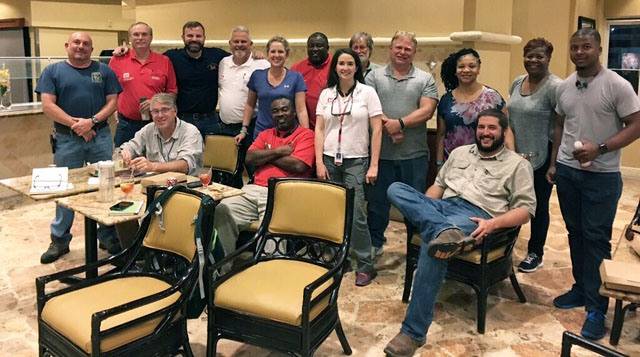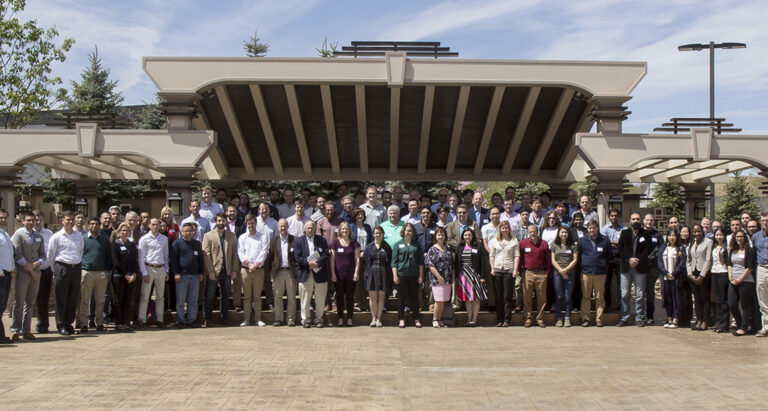
Attendees of the ADCIRC Users Group Meeting. Photo by Shangyao Nong.

ADCIRC Week expands tracks to accommodate wide range of applications

  Coastal modelers and decision-makers will gather this spring to teach, learn, discuss, plan and build capacity for a tool that provides decision support for hazards like storm inundation during tropical and extratropical cyclones. ADCIRC Week, a gathering of professionals, academics, students and officials, will be held April 9-13, 2018, at the National Oceanic and … Read more

Hypothetical hurricanes: Modeling coastal hazards in Rhode Island

This year’s hurricane season has been one of the most active on record, with devastating impacts on coastal communities, including eastern Texas, both coasts of Florida and all of Puerto Rico. While hurricanes Harvey, Irma and Maria slammed the Gulf and the Caribbean, communities further north are preparing for their own high-impact storm: a hypothetical … Read more

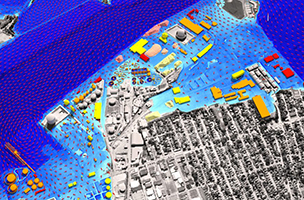
Policy simulations include visualization of commercial port properties impacted by potential sea-level rise. Illustration by Dr. Peter Stempel and Dr. Austin Becker.

Center credited in report from National Academies

  The ability to observe and predict severe weather events and other disasters has improved markedly over recent decades, yet this progress does not always translate into similar advances in the systems used in such circumstances to protect lives, according to a new report by the National Academies of Sciences, Engineering, and Medicine (NASEM). The … Read more

Princeville residents guide plan for future of town

Loria Martin was lucky this last time. Her home in Southern Terrace, a Princeville, N.C. neighborhood, was spared the flooding that impacted so much of eastern North Carolina when Hurricane Matthew hit the state in early October 2016. She has been supporting family members but is thankful damage to her home was limited to a … Read more

Q&A: Dr. Camellia Okpodu, Norfolk State University

Q&A: Dr. Camellia Okpodu, Norfolk State University

Dr. Camellia Okpodu, Professor of Biology at Norfolk State University, worked on a cross-university project with Coastal Resilience Center of Excellence (CRC) project lead Old Dominion University as part of the Department of Homeland (DHS) Security Science & Technology Directorate-funded Summer Research Team exchange program. Dr. Okpodu spoke about the scope of her project, her past experience with coastal hazards and her hopes for future collaboration.


Q: Can you describe your summer project’s goals and if you felt they were achieved?

A: The whole concept was having a systems approach to look at the idea of sea level rise. We are trying to understand how minorities, particularly under-served and under-represented groups in this area, respond to sea level rise and coastal flooding. From a dataset working with the University of Virginia, one of the outcomes was that minorities, particularly African-Americans, have a low affinity for the environment. That troubles me as an African-American person who grew up in coastal North Carolina on a farm – that is not my experience.

I wanted to be able to look into this, so when the DHS funding came about, I decided instead of just working by myself this was a way to work across universities in a multi-disciplinary way and to have a social scientist and students from that area who were interested in crime and social justice issues. This is how Dr. Bernadette Holmes got invited to participate.

I wanted to take this questionnaire from the University of Connecticut, not just to compare directly with what he got but to ask additional questions. For example, one of the things I thought was culturally sensitive and I wanted to look at is that most minorities – people that are my age – we don’t refer to this area as Hampton Roads. We grew up calling this Tidewater or 757. One of the questions put on our survey is how they identify their area where they live. 


Q: How would you describe the connection between the work you do in your home department and the coastal resilience realm?

A: I am primarily interested in the people of Portsmouth, Va. Portsmouth is an “economic empowerment area” – it’s about 96,000 people but they have a high rate of crime, high rate of asthma – this is primarily epidemiological data I could get. I was interested in those social indicators and finding out what we can do in the landscape from a biological aspect. Are there things we can do with dune plants for coastal restoration and mitigation? I worked on a long-term ecological project to learn about what types of plants we can add back. Rebuilding wetlands is very important for storm surge. We wanted to look into what could be done to the landscape on the basic level to help mitigate some of that. We already have some of that information, but we wanted to better identify the plants that would be most responsive and tolerant in that area. The Eastern Shore is very fertile for farmland, but as we have more flooding moving inland it’s not just us being affected. We are looking into whether there are epigenetic markers that we can see, expressed in the DNA of certain plants, that make them more flood-tolerant or stress-tolerant.
Read more

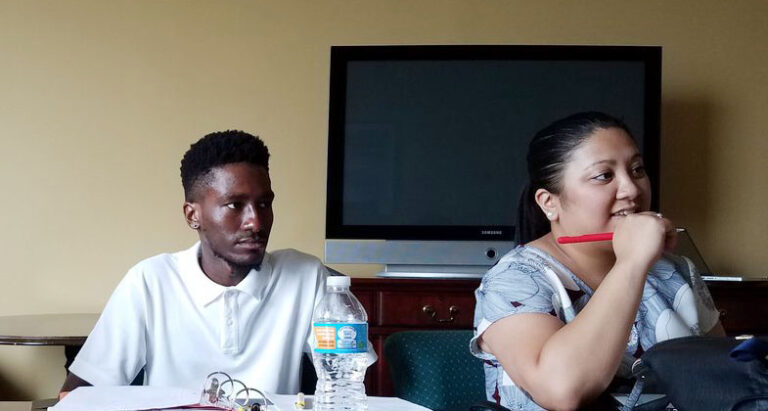
Norfolk State University students Mikel Johnson and Raisa Barrera participated in a summer research team project at Old Dominion University in 2018.

Summer research team focuses on disaster impacts on minority communities

This past summer, Old Dominion University (ODU) hosted a summer research team led by Norfolk State University (NSU) faculty Dr. Camellia Okpodu and Dr. Bernadette Holmes as part of an interdisciplinary, multi-institution collaborative summer research project. The project was titled “A Systems Approach:  Developing Cross-Site Multiple Drivers to Understand Climate Change, Sea-level Rise and Coastal … Read more

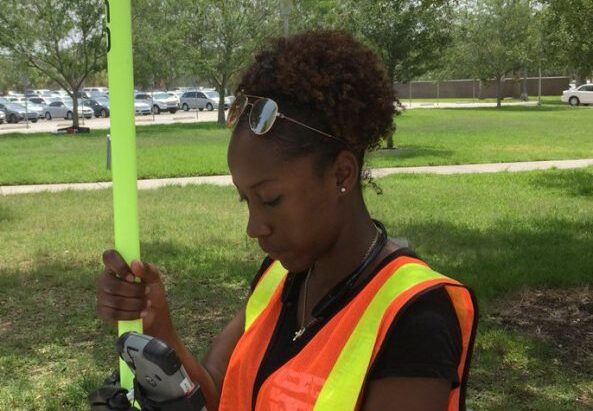
Sabrina Welch of Jackson State University learns about surveying at the University of Central Florida as part of the CRC's SUMREX program. Photo by Dr. Stephen Medeiros.

Students participate in second annual summer exchange program

For the second summer, undergraduate and graduate students in Coastal Resilience Center of Excellence (CRC) education programs were involved in a wide variety of academic exchange and professional internship programs, providing them the opportunity to gain important research skills and experience designed to aid their academic and future careers. Eight students who are enrolled in … Read more

Matrix McDaniel, far right, is a member of the U.S. Army Corps of Engineers Memphis District Power Team currently working in San Juan, Puerto Rico, to aid recovery from Hurricane Irma.

CRC graduate participates in Hurricane Irma recovery

A graduate of a Coastal Resilience Center of Excellence (CRC) education program is part of a U.S. Army Corps of Engineers (USACE) team aiding in Hurricane Irma recovery. Matrix McDaniel, a spring 2016 graduate of Jackson State University who earned his Bachelor of Science degree in Civil Engineering, is part of a 14-person USACE Memphis … Read more

port | photo by ronan furuta unsplash

HBCU experts gather for Flood and Hurricane Meeting

  The Department of Homeland Security’s (DHS) Coastal Resilience Center of Excellence (CRC) hosted their first Historically Black Colleges and Universities (HBCU) Flood and Hurricane Meeting Aug. 3-4, 2017, on the campus of Tougaloo College in Jackson, Miss. The CRC university network includes 21 universities and colleges from throughout the country. More than 30 researchers … Read more

Design teams develop options for Princeville


Residents urged to get involved

When Hurricane Matthew flooded Princeville last fall, it marked the second time in less than 20 years that a flood nearly wiped out the town. Local, state and federal leaders vowed to work with the community to help them recover and figure out solutions to help preserve one of the country’s most historically significant towns.

This week, local and state leaders will host a five-day community design workshop to bring together teams of land use planners, engineers, architects and landscape architects to collaborate with local, state and federal  officials to develop three scenarios for a new 52-acre tract of land that the state intends to buy. The parcel will include houses, businesses, infrastructure, public facilities and community open space in ways that ensure that the new space connects physically, socially, environmentally and economically to historic portions of town.          

“Princeville has a deep, rich history and incredibly resilient people,” said Dempsey Benton, Governor’s Recovery Office director who is leading the hurricane recovery efforts. “The town has a rare opportunity to develop a new portion of land that will be better able to withstand flooding while still preserving this historic community.”

The design workshop begins Friday, Aug. 25. Various local and state officials will make technical presentations to the designers to outline the planning and visioning process and also describe the culture and history of Princeville, review local codes and standards, flooding history, floodplain management and hazard mitigation programs. Additionally, they will discuss levee issues and proposed solutions, and review best practices and lessons learned from other community design projects across the country. Friday afternoon, local officials will lead the design teams on a tour of the community.

During the day Saturday through Monday, the design teams will create three conceptual plans for Princeville’s future. Each evening from 6 to 8 p.m., the three teams will present their ideas at an open house to gather feedback from local residents and town leaders, then adjust the designs based on input they receive. Residents are encouraged to come multiple nights to see the evolving designs as they change based on public input.

Read more