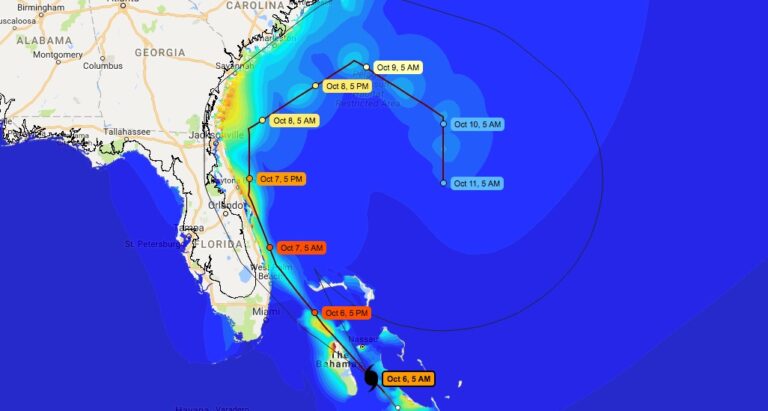

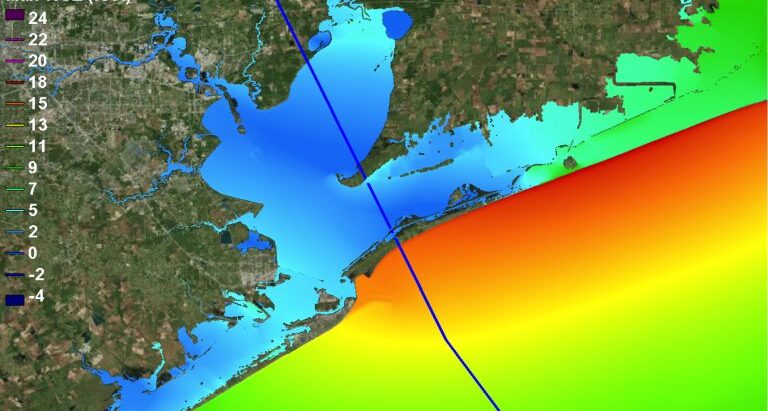
The CERA website shows Matthew's projected storm path and surge on Oct. 6, 2016, as the storm made its way up the East Coast.

RENCI and Coastal Resilience Center partnership honored with 2016 HPCwire Editors’ Choice Award

  The University of North Carolina at Chapel Hill’s Renaissance Computing Institute (RENCI) and the Department of Homeland Security Coastal Resilience Center of Excellence (CRC) have been recognized in the annual HPCwire Readers’ and Editors’ Choice Awards, presented at the 2016 International Conference for High Performance Computing, Networking, Storage and Analysis (SC16) in Salt Lake … Read more

Dr. Jen Horney

CRC project tracks long-term recovery in communities

Dr. Jennifer Horney believes that the quality of disaster recovery can be markedly improved with a well-designed, comprehensive and holistic pre-disaster recovery plan. Dr. Horney, of Texas A&M University, is the Principal Investigator on the Coastal Resilience Center project “Implementing the Disaster Recovery Tracking Tool.” Dr. Horney and research associate Katie Kirsch collect long-term data … Read more

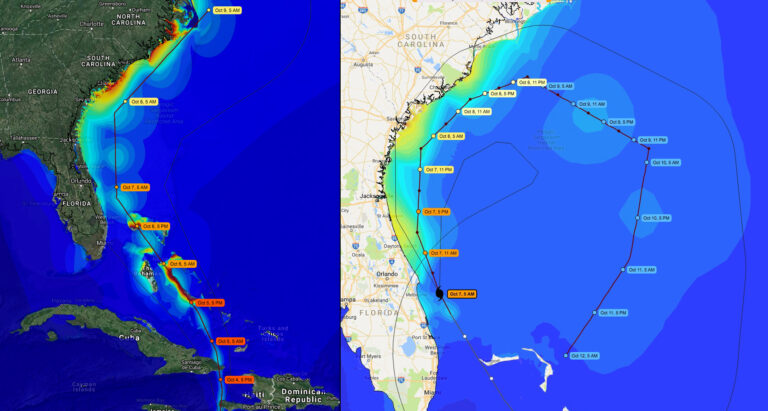
ADCIRC projections for storm surge locations and impact from Hurricane Matthew, as seen on these images from the CERA website, changed dramatically between Oct. 4 (left) and Oct. 7 (right).

Coastal Resilience Center researchers, partners aid in Hurricane Matthew preparation and recovery

  Researchers at the Coastal Resilience Center of Excellence (CRC) have been working with hurricane forecasters and emergency response officials to track Hurricane Matthew as it made its way through the Caribbean and up Florida to the Carolinas earlier this month. Using technology and tools being developed and improved through Center projects, they will continue … Read more

Kevin Cueto

Students reflect on summer research and internships

Undergraduate and graduate students in Coastal Resilience Center of Excellence (CRC) education programs were involved in a wide variety of academic exchange and professional internship programs this past summer, providing them the opportunity to gain important research skills and experience designed to aid their academic and future careers. Seven students from CRC Education & Workforce … Read more

Coastal Resilience Center researchers ‘making waves’ in hurricane mitigation

Researchers from Oregon State University and Colorado State University are conducting benchmark laboratory and numerical experiments to improve the resilience of coastal structures subject to hurricane waves and surge. Principal investigator Dr. Daniel Cox and co-Principal Investigator Dr. John van de Lindt are concluding the first phase of a multiphase project titled “Experimental and Numerical … Read more

Colleen Durfee

Center welcomes Science & Engineering Workforce Development fellows

Two new graduate students have joined the Coastal Resilience Center of Excellence (CRC) as fellows. This semester, Colleen Durfee and Darien Williams, both graduate students at the University of North Carolina at Chapel Hill (UNC), began as Science & Engineering Workforce Development Fellows. The Department of Homeland Security-funded program aims to ensure that students are … Read more

Dr. Wei Mei

CRC scientist publishes on typhoon strength in Nature Geoscience

Landfalling typhoons in East and Southeast Asia have been increasing in intensity, new research from a Coastal Resilience Center of Excellence (CRC) scientist shows. In an article published this month in Nature Geoscience, CRC Assistant Research Scientist Dr. Wei Mei shows that Asian typhoon intensity increased over nearly 40 years. Dr. Mei is lead author … Read more

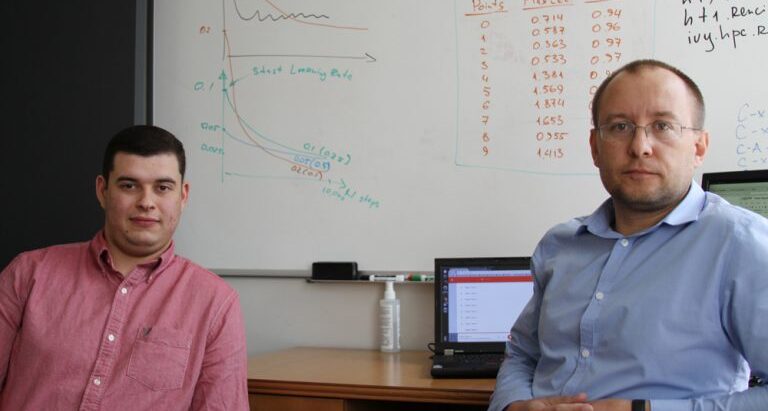
Dr. Anton Bezuglov, right, visiting faculty from Benedict College, worked with student Reinaldo Santiago, left, and CRC PI Dr. Brian Blanton on a project to speed up the ADCIRC storm-surge model while at UNC-Chapel Hill this summer.

Researcher uses neural networks to simulate storms

As part of a Department of Homeland Security-funded summer research team program at the Coastal Resilience Center (CRC), Principal Investigator Brian Blanton at the University of North Carolina at Chapel Hill hosted Dr. Anton Bezuglov, an Associate Professor of Computer Science at Benedict College in Columbia, S.C. The summer program focuses on matching researchers and … Read more

Hurricane Ike dike

Four projects improving on ADCIRC speed, reliability

The ADCIRC storm surge model is a major focus of Coastal Resilience Center research projects. Each of the four projects focus on making improvements to the model to allow faster simulations of flooding, both onshore and inland, in time-sensitive situations. The decreased response time will benefit coastal communities, including emergency management personnel, who will have … Read more

Todd Davidson

CRC Partners: Todd Davison, NOAA Office for Coastal Management

Todd Davison has managed the Gulf, Southeast and Caribbean Region for the NOAA Office for Coastal Management since 2006. A native of Baton Rouge, La., Davison was Director of the Federal Emergency Management Agency (FEMA) Region IV Mitigation Division and previously managed FEMA’s Technical Assistance and Compliance Branch. An expert in floodplain and coastal zone management programs who has been a member of the Coastal Resilience Center’s (CRC) Advisory Board since its earliest incarnation in 2008, Davison spoke with us about how his work and that of the CRC overlap.
 

Todd Davison
Todd Davison

Coastal Resilience Center: What originally interested you in coastal management as a professional field?

Todd Davison: I grew up in South Louisiana and as a kid I fished and hunted on the coast. I went through several hurricanes as a child, Hurricane Betsy in 1965 and Hurricane Camille in 1969; those left a huge impression on me, and I got really interested in the whole concept of coastal storms and impacts to the coast that I saw and experienced firsthand.


CRC: You worked for the state of Louisiana prior to joining FEMA. What lead your career in that direction?

Davison: As a kid, I grew up in a lower middle-class family that didn’t have a lot of money, and so there weren’t a lot of options for me to go to school anywhere but LSU in Baton Rouge. So I just worked my way through school there and ended up working in the geology department at the school. I guess I was a good enough graduate student that the Louisiana Geological survey, which had its offices on campus at the time, hired me.

One of the projects I worked on was the first set of maps of coastal floodplains in coastal Louisiana. It’s pretty commonplace now but back in the 1970s there weren’t a lot of good flood risk information pieces out there. They hired me to work the geological surveys to produce an atlas of flood risks and flooding. Bulky old paper atlases used to be state-of-the-art. Now they’re in museums, I think.

… Then I went up to D.C. and got a job working in the area flood mapping and floodplain management [program with FEMA]. They were really interested in my Louisiana experience because Louisiana is such a flood-prone state with all kinds of complicating issues like levees, storm surge and sea-level rise. They thought that my expertise down the Gulf Coast would help them run a national-level policy.

I got a chance to work with a congressional committee at the time helping draft what ultimately would become the National Flood Insurance Reform Act in 1994. I spent 10 years there then in a position for the regional director of mitigation division director in the Atlanta (Southeast) regional office. That division does all of the flood mapping, floodplain management, the rain system, hurricane evacuation programs, all the mitigation grants as well as a number of responsibilities for post-disaster mitigation. That’s how I crossed paths with [CRC Director Dr. Gavin Smith].

Read more